

AI: What NOT to Do. Don't Outsource Your Thinking, Beliefs or Values
AI can help you find answers. But are you remembering to ask your own questions?
Artificial intelligence has become an extraordinarily useful tool in both business and everyday life.
We can use it to save time, create content, research ideas, solve problems and explore possibilities we might otherwise have missed.
We can ask it to help us make a business decision, navigate a difficult relationship, plan a career change or make sense of a situation we don’t quite know how to handle.
It’s remarkably helpful, isn’t it?
But recently, I listened to a training that raised an important question:
How easily do we hand over our own authority when we’re looking for answers, reassurance or direction?
At what point does using AI to help us think become allowing AI to think for us?
I believe there are 5 Things we need to be careful NOT to hand over to AI.
1. Don't outsource your thinking
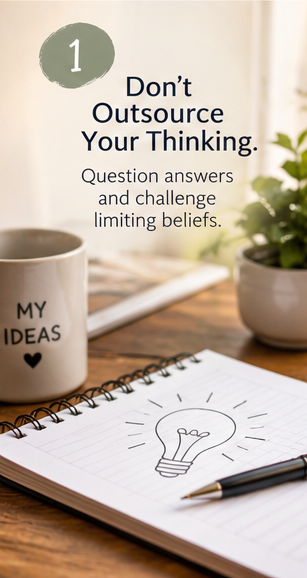
I use AI to explore ideas, challenge assumptions and consider alternatives.
It can be an excellent sounding board when I need to work through a problem or look at something from a different perspective.
But I don’t accept an answer simply because it sounds intelligent or is delivered with confidence.
AI can be remarkably agreeable.
Depending on how we frame our questions, it can reinforce our existing assumptions rather than challenge them.
And this is where things become particularly interesting.
We all have beliefs about ourselves, our capabilities and what’s possible for us.
Some beliefs support us.
Others may be holding us back without us even realising it.
Imagine telling AI:
- I’m too old to learn something new.
- I’m not good enough to grow my business.
- I’ve never been good at selling.
- People like me don’t succeed at that.
These statements might feel like facts because we’ve repeated them to ourselves for years.
But a BELIEF isn’t necessarily a fact, even when we’ve believed it for a long time.
Instead of asking AI to confirm what we already think, we can use it to question our assumptions.
Try asking:
- What evidence do I have for this belief?
- Where might this belief have come from?
- Am I confusing a past experience with a permanent limitation?
- What other explanations or possibilities have I overlooked?
This is a much more useful way to engage with AI.
It can help us examine our thinking, but it cannot do the inner work for us.
We still need to be willing to question what we’ve accepted as true and consider a different perspective.
Don’t just ask AI for answers.
Use it to ask better questions of yourself.
2. Don't hand over responsibility for your decisions
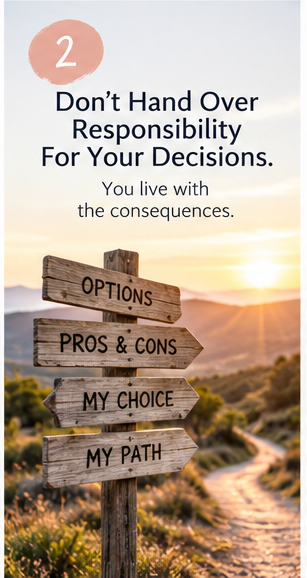
Whether you’re choosing a business direction, changing careers, managing money or navigating a difficult relationship, AI can help you understand your options.
It can help you weigh up the pros and cons, identify potential risks and consider consequences you might not have thought about.
But there is a fundamental difference between receiving guidance and handing over responsibility.
AI doesn’t have to live with the outcome. You do.
It doesn’t know every detail of your circumstances, and it cannot guarantee that its recommendations will be right for you.
Check important information. Seek qualified advice where necessary. Consider the people who may be affected by your choices.
Most importantly, take the time to decide what makes sense in the context of your own life.
You don’t have to follow a recommendation simply because an AI tool suggests it.
Use AI to help you think things through. Don’t ask it to take responsibility for choosing your path.
3. Don't outsource your humanity
Our empathy, lived experiences, relationships, creativity and capacity to care are part of what makes us human.
AI can help us write a message, prepare a presentation, organise a plan or find the words for a difficult conversation.
These are useful applications. But we need to make sure our own voice, perspective and genuine care remain part of what we share.
The same principle applies when we ask AI to help us navigate a disagreement or understand another person’s behaviour.
AI only knows the version of events we share with it.
It hasn’t heard the other person’s perspective, and it cannot fully understand the history and nuances of a relationship from a single account.
Its suggestions may help us see another possibility.
They shouldn’t automatically become our verdict on another person.
Sometimes, the next step isn’t another conversation with AI.
It’s a conversation with the person involved.
Technology can help us communicate, but it shouldn’t become a substitute for genuine human connection.
4. Don't replace your intuition with an algorithm
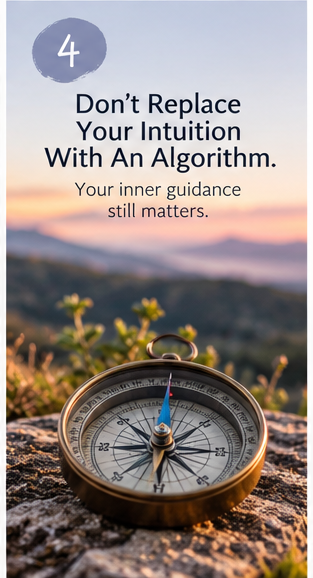
This is particularly important to me.
We all have our own ways of finding clarity.
For some, it’s quiet reflection. For others, it’s prayer, meditation, intuition or working with tarot and oracle cards.
I believe there is value in making space to pause, reflect and listen to what is happening within us rather than immediately searching outside ourselves for an answer.
AI can help us explore the symbolism of a card, consider different interpretations or reflect on a situation from another perspective.
But it cannot determine what a card means to us personally, nor can it verify what we experience as spiritual guidance.
The same applies when we’re making a difficult life or business decision.
Sometimes, an option looks perfectly sensible on paper, yet something about it doesn’t sit comfortably with us.
That feeling deserves our attention. It may be pointing towards a concern we haven’t fully acknowledged, a value we haven’t considered or an assumption worth examining.
Of course, intuition isn’t infallible.
Our feelings can also be influenced by fear, habit and past experiences. We need to be willing to explore those possibilities, too.
The point isn’t to choose intuition over reason, or reason over intuition.
It’s to give ourselves the space to consider both.
Let AI help you explore the possibilities. Don’t let it decide what your inner guidance is telling you.
5. Don't outsource your values
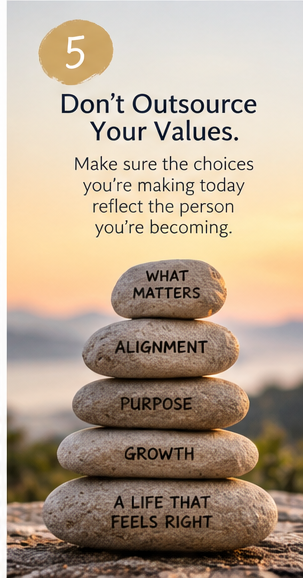
AI can help you weigh up your options, explore different perspectives and make sense of a situation.
But it shouldn’t decide what matters most to you.
Your values influence the decisions you make, the relationships you nurture, the work you choose and the life you build.
Here’s something worth remembering:
The values that guided you ten years ago may not be the same ones guiding you today.
As we grow, learn and move into new chapters of our lives, our priorities can change.
Something that once mattered enormously might become less important, while something we previously overlooked moves to the top of the list.
Perhaps professional recognition once mattered more than freedom. Perhaps financial security has become more important. Perhaps you have reached a point where meaningful work, flexibility or time with the people you love matters more than pursuing the next achievement.
There is nothing wrong with reassessing what matters to you.
In fact, it can be an important part of personal and professional growth.
Every now and then, take a little time to ask yourself:
- What’s genuinely important to me at this stage of my life?
- Are my decisions reflecting those values?
- Am I still pursuing something because I want it, or because it’s what I’ve always done?
- Have my priorities changed, even though my choices haven’t?
AI can help you explore these questions. But it cannot define your values for you.
You are allowed to outgrow an old version of yourself.
Make sure the choices you’re making today reflect the person you’re becoming.
What does this have to do with changing our beliefs?
There is a common thread running through all five points.
The way we think influences the beliefs we hold.
Our beliefs can influence how we interpret experiences, the possibilities we recognise and the decisions we make.
Over time, familiar patterns of thinking and responding can become deeply ingrained.
We may continue approaching our businesses, careers and relationships in the same way, even when our circumstances have changed.
We might tell ourselves that we’re not good at something, that it’s too late to try something different or that we have to keep doing things the way we’ve always done them.
Sometimes, these beliefs go unchallenged because they feel so familiar that we no longer recognise them as beliefs.
We simply accept them as the truth.
This is why questioning our assumptions matters. (Especially those generatated by AI.)
Our brains have the capacity to change through learning, experience and repeated practice. But changing an established pattern usually takes more than a single positive thought or a decision to think differently.
It takes awareness, reflection and a willingness to practise new ways of thinking and responding.
AI can be useful here. It can help us identify assumptions, explore alternative perspectives and ask questions we might not have considered.
But recognising a belief is only part of the process.
We also need to examine where it may have come from, whether it remains useful and what we might do differently.
Sometimes, the answer isn’t another strategy. It’s recognising the belief that’s been shaping every strategy you’ve tried.
When your business or life no longer fits who you’ve become
This is particularly relevant when we’re experiencing a period of change.
Perhaps your business has evolved, but your positioning, offers or pricing haven’t kept pace.
Perhaps you’re still pursuing goals that made sense years ago, but no longer reflect what you want from your work or your life.
Or perhaps you know something needs to change, but you haven’t yet worked out what that change should look like.
It’s tempting to search for another strategy, another course or another answer.
And AI can certainly help you explore possibilities.
But before rushing into action, it may be worth asking a different question:
Is the problem really my strategy, or has something changed in me that my current strategy no longer reflects?
When our values, beliefs, priorities or sense of direction change, the choices that once worked for us may no longer be the right choices.
This doesn’t necessarily mean we have failed or that everything needs to be abandoned.
It may simply mean that it’s time to reassess, realign and make more conscious decisions about what comes next.
That process starts with understanding where you are now, what matters to you and what may be getting in the way of moving forward.
Use AI as a sounding board, not your compass.
I’m not suggesting we stop using AI. Far from it.
It can be a valuable tool for business owners, professionals and anyone navigating change.
But we need to remain conscious of how we use it.
Use it to expand your thinking, not replace it.
Use it to explore possibilities, not dictate your choices.
Use it to question your assumptions, not simply confirm them.
And remember that an answer can sound convincing without being correct, complete or appropriate for your circumstances.
The responsibility for checking the information, weighing up the options and making the final decision remains yours.
Your lived experience, values, judgement and personal sense of direction still matter.
Because AI can help you find the questions. It can help you explore the answers.
But it cannot live your life for you.
Let AI be a sounding board, not your compass.
And if something in your business or life no longer feels aligned, perhaps the next step isn’t to ask AI for another answer.
Perhaps it’s time to look more closely at what has changed, what you believe and what you really want from this next chapter.
Sometimes, that’s where meaningful change begins.
About RedMatchstick
I’m Suze Bouwer, founder of RedMatchstick. I work with business owners and professionals who recognise that something has changed and want to bring their direction, decisions and actions back into alignment with who they are today.
My work centres on helping people gain clarity, question assumptions and explore the beliefs and patterns that may be influencing their choices.
Because moving forward isn’t always about doing more. Sometimes, it’s about understanding what needs to change, and making choices that reflect who you are becoming.
If your business or career no longer fits the person you’ve become, let’s explore what needs to realign.
Visit RedMatchstick.com to learn more about my work.